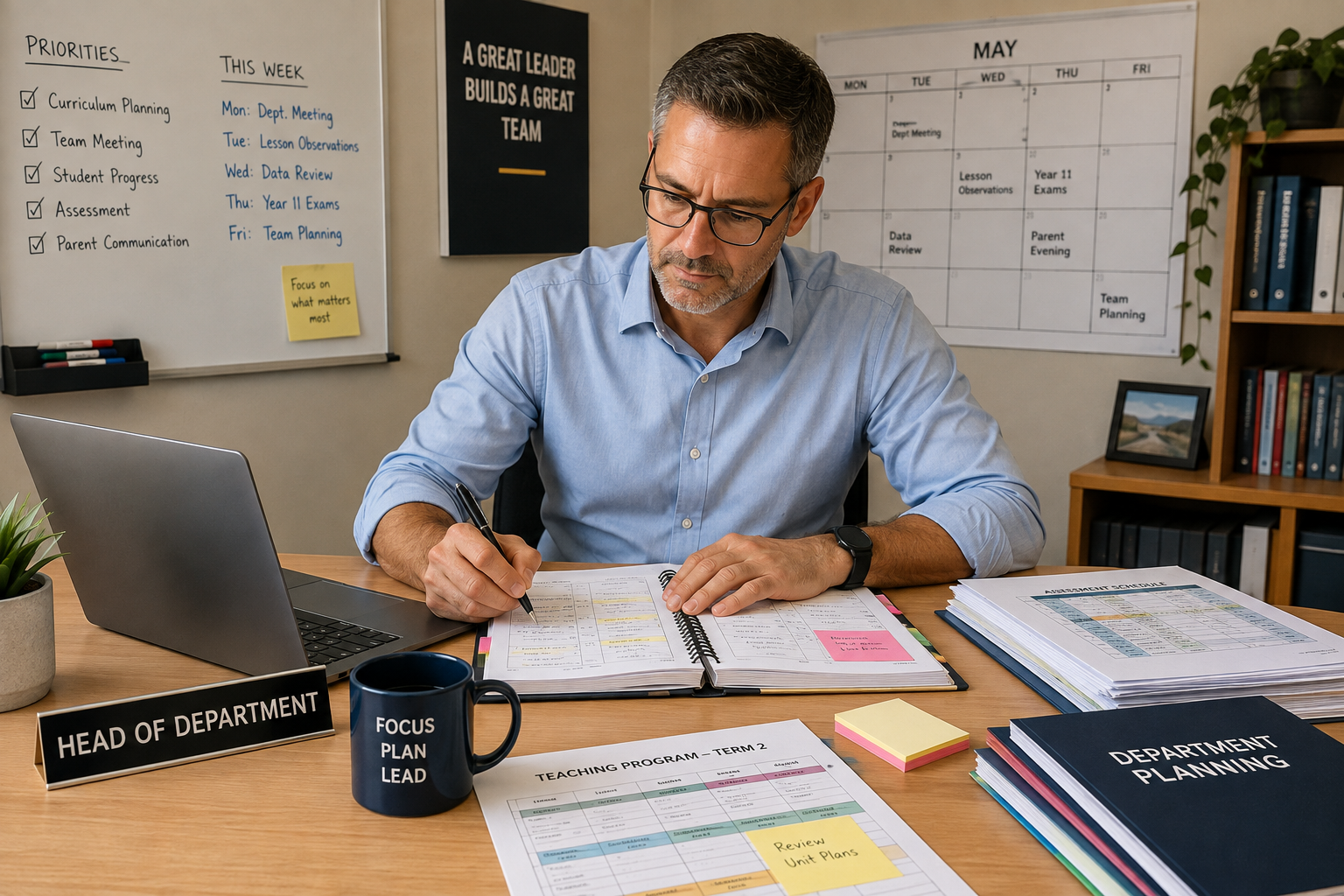
Personal organization for HODs is essential if you want to stay productive, manage your workload and remain in control of your department.
Being a Head of Department is demanding because your attention is constantly being pulled in different directions. You may begin the morning intending to work on curriculum planning, only to find yourself dealing with a student issue, supporting a teacher, responding to an email from senior leadership and attending an unexpected meeting.
Then, when the day finally ends, the work you originally planned to complete is still waiting for you.
The answer is not simply to work longer hours.
Effective personal organization for HODs is about creating systems that help you decide what deserves your attention, when you should deal with it and what can wait.
The goal is not to become perfectly organised. The goal is to make it easier to concentrate on the work that has the greatest impact on teachers, students and your department.
1. Personal Organization for HODs Starts with Priorities
One of the biggest challenges for an HOD is distinguishing between urgent tasks and important tasks.
Everything can appear urgent when you are responsible for a department.
An email may need an immediate response. A teacher may need assistance. A report may have a deadline. A parent may be waiting for a response. Meanwhile, the curriculum planning you intended to complete may continue to be pushed aside.
This is where a clear prioritisation system becomes valuable.
A simple daily task list is a good starting point. At the end of each day, identify the most important tasks for the following day. Alternatively, spend five minutes at the beginning of the morning establishing your priorities.
Don’t create a list of 20 tasks.
Instead, identify:
- One or two high-priority tasks that require focused attention.
- Several important but routine tasks that need to be completed.
- Tasks that can wait if something more important arises.
The Eisenhower Decision Matrix can also help you distinguish between tasks that are urgent, important, both or neither.
This becomes particularly useful when you suddenly have 20 minutes of unexpected free time. Rather than asking yourself what you should do, you already have a list of worthwhile tasks from which to choose.
2. Personal Organization for HODs Requires a Reliable Calendar
A task list tells you what needs to be done. A calendar helps you decide when it will be done.
Your calendar should contain more than meetings and appointments.
Use it to schedule important work such as:
- Curriculum planning
- Data analysis
- Lesson observations
- Staff development
- Parent communication
- Performance management
- Department planning
- Report writing
- Administrative deadlines
If you simply keep these tasks on a to-do list, they can easily be displaced by more immediate demands.
Instead, allocate time for them.
For example, if you know that you need two hours to analyse your department’s assessment data, put that time into your calendar rather than hoping you will find two hours later in the week.
Microsoft Outlook can be particularly useful for HODs because it combines email, appointments, meetings and task management. Many schools already provide Microsoft 365, meaning you may already have access to the tools you need.
The important thing is not which calendar you use.
The important thing is using one reliable system consistently – here’s one I like.
3. Protect Your Time for High-Value Work
One of the most important aspects of personal organization for HODs is learning to protect time for work that requires concentration.
HODs often operate in an environment of constant interruption. Teachers walk into your office, emails arrive, students need assistance and meetings appear on the calendar.
Some interruptions are unavoidable.
Others are not.
Try identifying periods during the week when you can work without interruption. Use this time for tasks that require genuine concentration rather than routine administration.
You might, for example, reserve an hour on Wednesday morning for curriculum planning and another hour on Friday afternoon for reviewing student performance data.
During these periods, close unnecessary email notifications and avoid checking messages every few minutes.
You are not being unavailable.
You are protecting time to perform an important leadership responsibility.
4. Organise Your Workspace
A cluttered workspace can make an already demanding job feel even more chaotic.
You don’t need a perfectly minimalist office, but you should be able to find the information you need quickly.
Create a simple system for organising physical documents.
For example, you might have separate locations for:
- Current priorities
- Staff matters
- Curriculum documents
- Student information
- Meetings
- Documents requiring action
- Completed work
The same principle applies to your computer.
Create a logical folder structure and use consistent file names. Avoid having important documents scattered across your desktop, downloads folder and email inbox.
A useful question is:
If I needed this document three months from now, could I find it within two minutes?
If the answer is no, your system probably needs some attention.
Good organisation is not about making your workspace look tidy. It is about reducing the amount of time you waste searching for information.
5. Use Technology to Simplify Personal Organization for HODs
Technology can either make an HOD’s workload easier or make it considerably more complicated.
The key is to use technology selectively.
You don’t need ten different productivity applications. In many cases, the tools already available through your school are sufficient.
Use digital tools to:
- Manage your calendar
- Set reminders
- Store documents
- Share resources
- Collect staff feedback
- Track important deadlines
- Collaborate with colleagues
- Record actions from meetings
For example, Padlet can be useful when you want staff to contribute ideas or respond to a question without requiring everyone to attend another meeting.
The current version of this article highlights Padlet for exactly this purpose: posing a question, distributing the link and allowing staff to contribute when convenient.
The broader principle is simple:
Use technology to reduce administration, not create more of it.
Before introducing a new app or system, ask whether it will genuinely save time.
If it doesn’t, don’t use it.
6. Personal Organization for HODs Means Managing Email
Email can consume a surprisingly large proportion of an HOD’s working day.
The problem is not email itself. The problem is allowing your inbox to determine what you work on.
Try establishing specific times to process email rather than checking it continuously.
For example, you might check your inbox:
- At the beginning of the day
- Around lunchtime
- Towards the end of the day
Obviously, some messages will require an immediate response. However, most emails do not need to interrupt whatever important work you are currently doing.
When you open an email, decide what action is required.
You can:
Delete it if it is unnecessary.
Delegate it if someone else should deal with it.
Respond if the answer will take only a few minutes.
Schedule it if it requires more substantial work.
File it if you need to retain it but no action is required.
This simple approach can prevent your inbox from becoming another uncontrolled to-do list.
7. Learn to Say No and Delegate
Personal organization for HODs is not simply about becoming better at doing more work.
Sometimes the best organisational decision is deciding not to do something yourself.
HODs often become overloaded because they attempt to personally handle tasks that could be delegated to other members of the department.
Delegation is not about avoiding responsibility.
It is about developing the capacity of your team while allowing you to concentrate on higher-level responsibilities.
Consider whether appropriate tasks can be delegated to:
- Subject coordinators
- Experienced teachers
- Teacher leaders
- Administrative staff
- Other members of the leadership team
When delegating, be clear about the expected outcome and the deadline. Then allow the person to take responsibility for completing the task.
Similarly, learn to say no—or at least not yet—when another request would prevent you from completing a higher-priority responsibility.
8. Take Regular Breaks
Effective personal organization for HODs also means recognising that you cannot operate at maximum intensity all day.
It is easy for HODs to become trapped in a cycle of meetings, emails, teaching, problem-solving and administration without taking a proper break.
That is not sustainable.
Short breaks can help you reset your attention and return to demanding tasks with greater concentration.
Where possible, step away from your desk. Get some fresh air. Have lunch away from your computer. Give yourself a few minutes without another problem demanding your attention.
Taking a break is not wasted time.
It is part of maintaining the energy and concentration required to lead effectively.
9. Create a Personal Organization System That Works for You
There is no single perfect system for personal organization for HODs.
Some HODs prefer paper planners. Others rely almost entirely on digital calendars and task lists. Some organise their work week in detail, while others prefer a more flexible approach.
What matters is creating a system that you will actually use.
Start with four basic questions:
- What are my most important responsibilities?
- Where do I record my tasks and deadlines?
- When will I complete my most important work?
- Where will I store the information I need?
If you can answer those questions quickly, you already have the foundations of an effective organisational system.
Then review the system regularly.
Ask yourself what is working, what is causing frustration and where you are repeatedly losing time.
Make adjustments.
Final Thoughts: Stay Organised Without Becoming Overwhelmed
The purpose of personal organization for HODs is not to squeeze more work into every available minute.
It is to create enough structure that you can concentrate on what matters.
Start by identifying your priorities. Use a reliable calendar. Protect time for important work. Keep your physical and digital workspace organised. Use technology selectively. Manage your email rather than allowing it to manage you. Delegate appropriate responsibilities and take proper breaks.
Most importantly, remember that being organised does not mean being constantly busy.
A successful HOD needs time to think, plan, analyse, support teachers and make good decisions.
The best personal organization system is therefore not the one that helps you do the most work.
It is the one that helps you spend your limited time on the right work.
That is ultimately what effective personal organization for HODs is about: creating the time, focus and structure you need to lead your department effectively.
Does anyone want to share their tips for remaining organized? Please leave a comment below.
