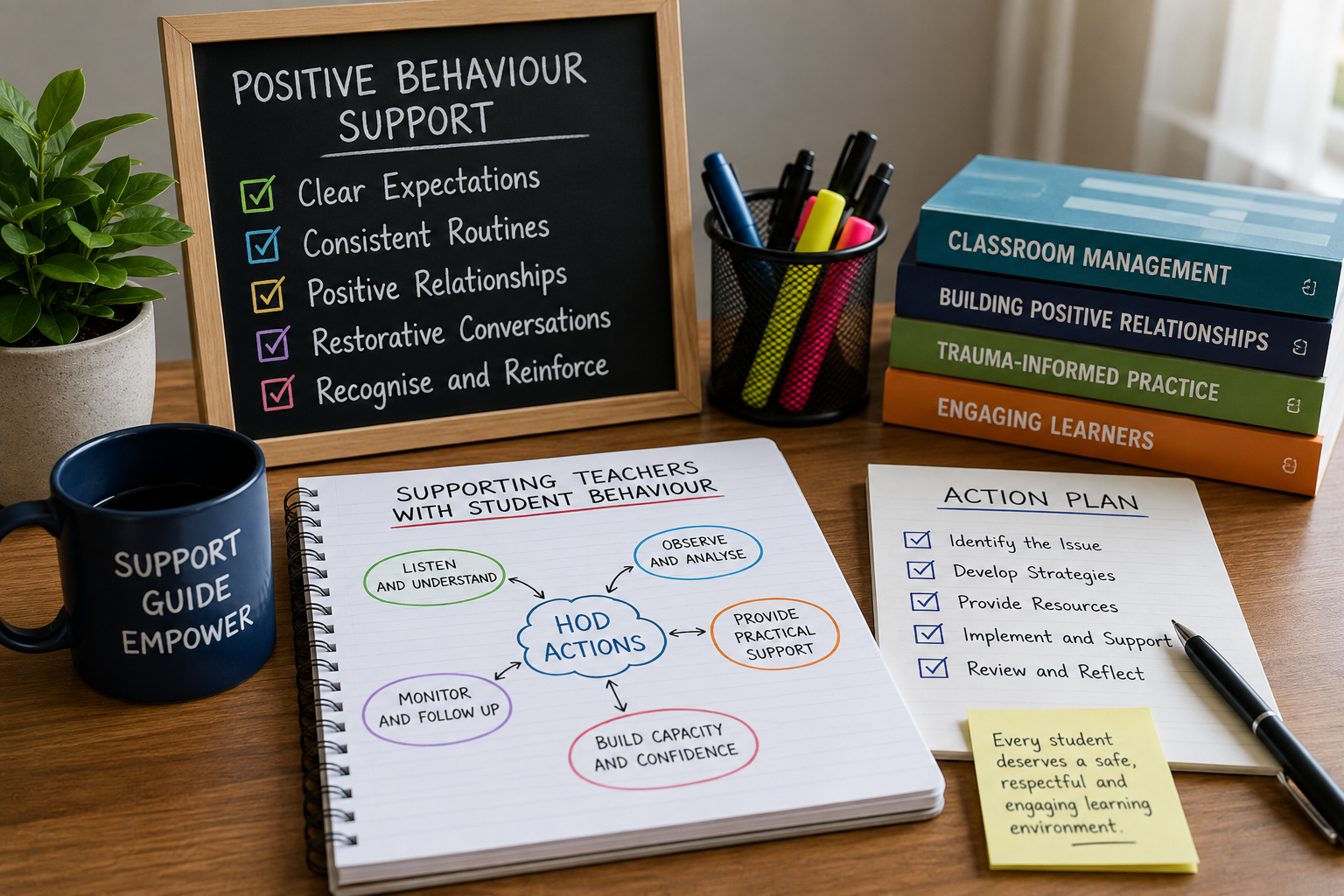
Helping teachers manage student behavior is one of the most important responsibilities of a Head of Department.
When a teacher is struggling with challenging behavior, the problem rarely affects only that teacher. Disruptive classrooms can reduce student learning, damage teacher confidence and create frustration across the department.
As an HOD, however, your role is not simply to tell a teacher to “improve their classroom management”.
Effective HOD leadership involves understanding what is happening, identifying the underlying causes, providing practical support and ensuring that reasonable behavior expectations are consistently maintained.
Helping teachers manage student behavior is therefore both a leadership responsibility and an opportunity to strengthen teaching across the entire department.
Helping Teachers Manage Student Behavior Starts with Understanding the Problem
When a teacher reports ongoing behavior problems, the first response should be curiosity rather than judgement.
“Students won’t listen” or “This class is impossible” may accurately describe how the teacher feels, but these statements do not provide enough information to determine what is actually happening.
Before deciding what support is required, gather some specific information.
Ask questions such as:
- When does the behaviour usually occur?
- Which students are involved?
- What behavior is causing the greatest difficulty?
- Does it occur during particular activities?
- Does it happen at particular times of the lesson?
- What happens immediately before the behavior?
- How does the teacher currently respond?
- Are there particular students who consistently trigger problems?
- Is the same behavior occurring in other classes?
Classroom observation can also be extremely valuable.
An observation should not automatically be treated as an evaluation of the teacher. Its purpose may simply be to understand the classroom dynamics.
Sometimes the problem becomes much clearer when you see the lesson for yourself.
Look Beyond the Behavior
Student behavior is often a symptom rather than the underlying problem.
A student who regularly calls out may be bored, disengaged, seeking attention or struggling with the work.
A class that becomes noisy during independent activities may not understand what they are expected to do.
Students may also respond differently to different teachers because classroom routines, relationships and expectations vary.
This does not mean the teacher is necessarily responsible for the behavior.
It means that helping teachers manage student behavior requires you to understand the circumstances in which the behavior occurs.
Look at the whole picture.
Consider:
- The students involved
- The teacher’s classroom routines
- The difficulty of the work
- Student engagement
- Classroom layout
- Lesson structure
- Relationships between students
- Behavior expectations
- Existing school policies
- Previous interventions
This broader approach prevents the HOD from immediately assuming that the problem is simply a lack of teacher competence.
Help Teachers Establish Clear Expectations
Students are more likely to meet behavioral expectations when those expectations are clear, consistent and predictable.
If a teacher is experiencing persistent behavior problems, one useful starting point is to examine the routines operating in the classroom.
Does the teacher have a consistent process for:
- Entering the classroom?
- Starting the lesson?
- Getting students’ attention?
- Moving between activities?
- Asking questions?
- Completing independent work?
- Using technology?
- Finishing the lesson?
These routines may appear insignificant, but they can have a substantial influence on classroom behavior.
As an HOD, you can work with the teacher to identify one or two routines that need strengthening rather than attempting to change everything simultaneously.
For example, a teacher might introduce a consistent lesson-starting routine in which students enter, sit down, take out the required materials and begin a short activity displayed on the board.
The objective is not to create a rigid classroom.
It is to reduce uncertainty and establish predictable expectations.
Help Teachers Respond Consistently
One of the most difficult aspects of classroom management is deciding what to do when a student does not meet expectations.
Teachers can become frustrated when they feel they are constantly correcting the same behavior without seeing improvement.
This is where consistency becomes important.
Teachers need to know:
What behavior is unacceptable?
What response will occur when it happens?
What happens if the behavior continues?
The school’s behavior management policy should provide the framework for these decisions.
As an HOD, you should ensure that teachers understand the relevant processes rather than expecting them to develop completely different approaches independently.
Consistency across the department is particularly important.
Students quickly recognise when expectations differ dramatically between classrooms.
This does not mean every teacher should manage behavior in exactly the same way. Teachers have different personalities and teaching styles.
However, the department should have common expectations about significant behaviors and how persistent problems are escalated.
Provide Practical Support, Not Just Advice
Telling a teacher to “be more consistent” or “establish better relationships with students” is unlikely to solve a difficult classroom.
If you want to help, provide practical support.
This might involve:
- Observing a lesson
- Demonstrating a particular strategy
- Helping the teacher plan a difficult lesson
- Discussing individual students
- Reviewing classroom routines
- Organising peer observation
- Providing behavior-management resources
- Arranging mentoring
- Working with student services
- Contacting parents where appropriate
- Involving relevant members of the school’s leadership team
Sometimes the most useful intervention is surprisingly simple.
A teacher might know exactly what they need to do but lack the confidence to implement it.
In other situations, they may need someone to help them think through a particular class or student.
Helping teachers manage student behavior is about removing barriers to effective action.
Focus on Relationships as Well as Rules
Effective behavior management is not simply about rules and consequences.
Relationships matter.
Students are more likely to respond positively to teachers who demonstrate that they know their students, understand their needs and genuinely want them to succeed.
This does not mean teachers should try to be friends with students.
Professional relationships can still involve firm boundaries.
Encourage teachers to learn students’ names, acknowledge positive behavior and communicate high expectations.
A teacher can be both supportive and demanding.
In fact, students often respond well when they understand that a teacher is maintaining high expectations because they believe students are capable of meeting them.
This is particularly important when a teacher has developed a negative perception of a particular class.
Helping the teacher identify successful interactions and positive moments can gradually change the way they approach the class.
Avoid Making the Teacher Dependent on the HOD
There is an important distinction between supporting a teacher and taking over their classroom management.
If an HOD is constantly called to remove difficult students, speak to students or resolve classroom incidents, the teacher may become increasingly dependent on the HOD.
That is not sustainable.
Your goal should be to build the teacher’s capacity.
When you intervene, discuss what happened afterwards.
Ask:
- What worked?
- What didn’t work?
- What could you try differently?
- What support would help?
- What will you do next time?
The teacher should gradually become more confident in managing similar situations independently.
The HOD remains available when escalation is genuinely necessary, but the teacher develops greater ownership of the classroom.
Use Data to Identify Behavior Patterns
Student behavior problems can sometimes be better understood by looking at available evidence.
Consider whether behavior incidents are concentrated:
- In particular classes
- At particular times
- During particular activities
- Among particular student groups
- Around particular students
- During particular parts of the school year
School behavior records can provide useful information, but they should not be the only source of evidence.
One method I have encouraged teachers to try is to take a class list and, next to each student’s name, list as objectively as possible, the precise behaviors that are problematic. They should also add any details about when the behavior occurs and who else is involved. This has two benefits: listing the behaviour in objective terms makes it easier to come up with strategies, and; it shows the teacher that in that “terrible class”, most of the students don’t misbehave. This can help to alter their perspective on the class and tackle behavior issues in a more practical, less emotive way.
Teacher observations, student attendance, engagement and academic performance may also reveal patterns.
For example, a class experiencing repeated behavior problems during extended writing tasks may also be producing significantly weaker work.
The issue may therefore involve both behavior and learning.
This reinforces an important principle:
Behavior management and teaching quality cannot always be separated.
Students who understand the work, know what they are expected to do and experience successful learning are often easier to engage.
Build Consistency Across the Department
Helping teachers manage student behavior becomes much easier when the department has a strong culture of consistency.
As HOD, establish shared expectations around significant behavior issues.
Your department might agree on:
- Common classroom routines
- An established seating plan for each class
- Expectations for student conduct
- Approaches to lateness
- Mobile phone expectations
- Responses to persistent disruption
- When behavior should be escalated
- How incidents are recorded
- When parents or caregivers should be contacted
The aim is not to eliminate teacher autonomy.
Instead, teachers should know that they are part of a team with shared expectations and support.
This is particularly important for beginning teachers.
A new teacher should not have to work out the school’s behavior systems entirely by themselves.
Support Teachers Without Lowering Expectations
There is sometimes a misconception that supporting a teacher with behavior management means making excuses for poor classroom practice.
It does not.
An effective HOD can demonstrate empathy while maintaining professional expectations.
You can acknowledge that a teacher is struggling while still making it clear that student behavior needs to improve.
The message might be:
“I can see that this class is creating significant challenges, and I want to help you address them. At the same time, we need to establish a plan that improves the situation.”
This approach avoids two extremes.
The HOD should neither blame the teacher for every behavior problem nor excuse ineffective practice simply because the situation is difficult.
The objective is improvement.
Create a Plan and Follow Up
Finally, helping teachers manage student behaviour requires follow-up.
A conversation about classroom management is unlikely to change anything unless it leads to action.
Agree on a small number of specific strategies.
For example:
Goal: Improve student behavior during independent work.
Action: Introduce a consistent five-minute instruction and preparation routine before independent tasks.
Support: HOD observes one lesson and provides feedback.
Review: Meet again after two weeks.
Evidence: Compare classroom observations and behavior incidents before and after the intervention.
Keep the process manageable.
Trying to introduce ten different strategies simultaneously makes it difficult to determine what is actually working.
Choose one or two priorities, implement them consistently and review the results.
Final Thoughts: Build Teacher Confidence and Student Success
Helping teachers manage student behavior is not about finding a single classroom-management technique that works for everyone.
It is about understanding the problem, providing practical support and building teacher confidence.
Start by gathering evidence rather than making assumptions. Help teachers establish clear routines and expectations. Encourage consistent responses to behavior. Support professional relationships with students and use observation, mentoring and collaboration where appropriate.
At the same time, maintain professional accountability.
Teachers need to know that the HOD will support them when classrooms become difficult, but they also need to develop the skills and confidence to manage their own classrooms effectively.
The best HODs do not simply solve behavior problems for teachers.
They develop teachers who are better equipped to solve those problems themselves.
That is the real purpose of helping teachers manage student behavior: creating classrooms where teachers can teach effectively, students can learn successfully and the entire department operates with greater confidence and consistency.
