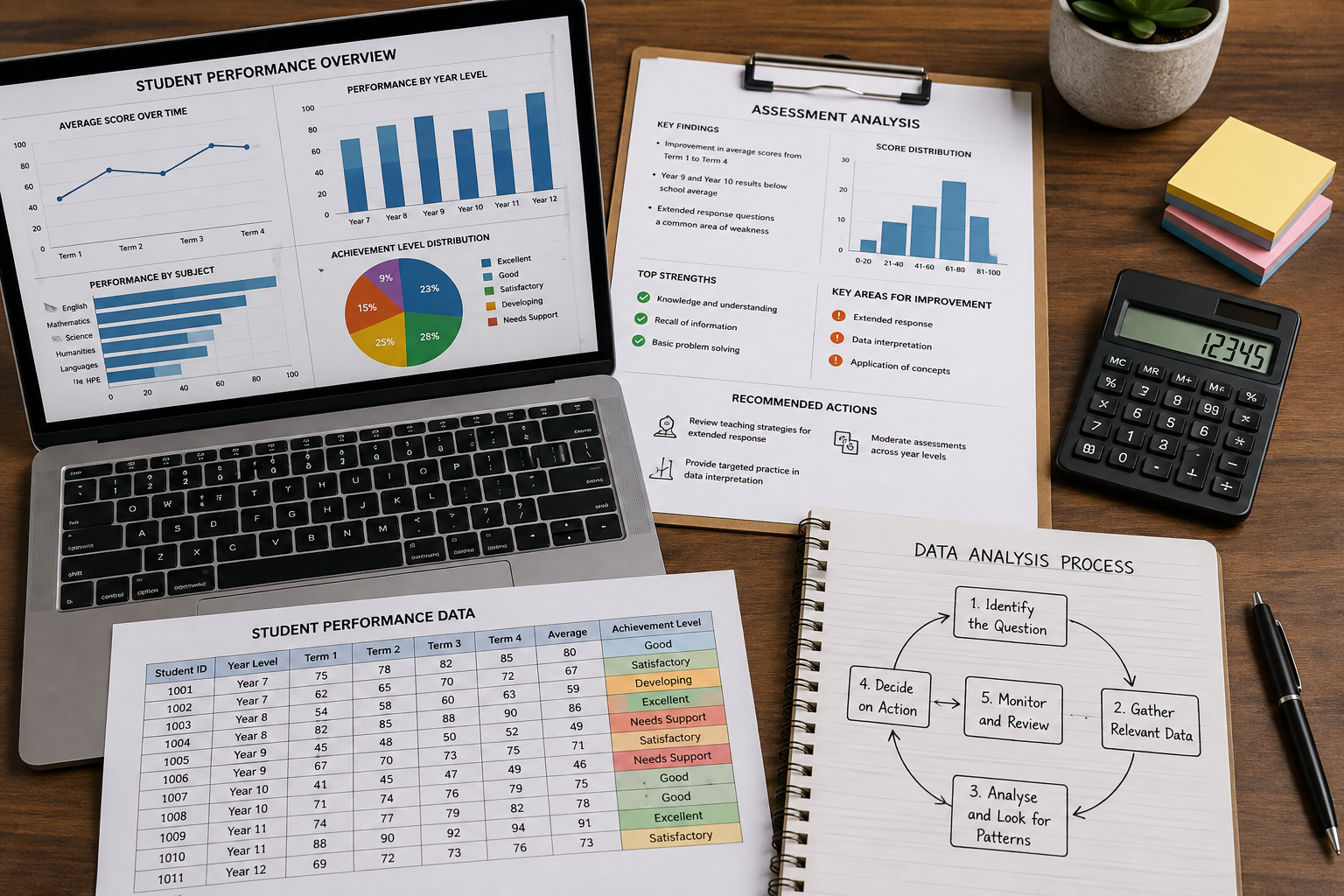
Student performance data can be one of the most valuable tools available to a Head of Department. It can reveal patterns that are difficult to see in individual classrooms, identify students who need additional support and help a department determine whether its teaching strategies are producing the desired results.
However, data is only useful when it leads to better decisions. Effective HODs do not simply collect spreadsheets, compare percentages or identify which teachers have the highest results. They use evidence to ask better questions, investigate possible causes and decide what the department should do next.
Learning how to analyse student performance data as an HOD therefore involves much more than reading assessment results. It requires a structured process that connects evidence with professional judgement and action.
How to Analyse Student Performance Data as an HOD: Start With a Clear Question
One of the most common mistakes HODs make is looking at data without first deciding what they want to find out.
A spreadsheet containing hundreds of student results can reveal almost anything — but that does not mean everything it reveals is important.
Before examining the data, establish a clear question.
For example:
- Which curriculum areas are students struggling with?
- Are student results improving or declining?
- Are particular year groups performing below expectations?
- Are there significant differences between classes?
- Which students may require additional intervention?
- Are students performing differently across different types of assessment?
A clear question gives your analysis a purpose.
Instead of asking, “What does the data tell us?”, ask, “What do we need to know, and what evidence can help us answer that question?”
Gather the Right Student Performance Data
The next step is to identify the evidence that can help answer your question.
Depending on the department and the issue being investigated, useful data might include:
- Assessment results
- Common assessment results across classes
- Individual student grades
- Standardised testing data
- Student work samples
- Formative assessment results
- Attendance information
- Student progress over time
- Assessment item or skill-level results
- Teacher observations
It is important not to assume that more data automatically produces better decisions.
For example, if students have performed poorly on a particular assessment skill, examining that assessment alongside student work samples may be much more useful than adding another large dataset.
The goal is to collect relevant evidence, not simply more information.
How to Analyse Student Performance Data: Look for Patterns
Once you have established the question and gathered relevant evidence, look for patterns.
A single result rarely tells the whole story. Patterns are much more informative.
Look for Patterns Across Students
Are the same students consistently struggling?
If so, consider whether they have common characteristics. Do they have gaps in prerequisite knowledge? Are attendance issues affecting their learning? Do they require additional intervention or differentiated support?
Look for Patterns Across Classes
If one class is performing significantly differently from another, investigate before drawing conclusions.
There may be differences in student cohorts, attendance, assessment conditions, curriculum coverage or teaching approaches.
The data should prompt questions rather than automatically assigning blame.
Look for Patterns Across Skills
This can be particularly valuable.
Suppose students achieve reasonable overall grades but consistently perform poorly when required to analyse information, interpret evidence or construct extended responses.
The overall grade may conceal an important teaching and learning issue.
Breaking assessment results down into individual skills can reveal exactly where students are experiencing difficulty.
Look for Patterns Over Time
Compare current results with previous assessments or cohorts where appropriate.
Ask:
- Is performance improving?
- Is it declining?
- Has a particular problem persisted?
- Did an intervention produce an improvement?
- Are recent results consistent with previous patterns?
Looking at trends helps prevent HODs from overreacting to one unusual assessment result.
Don’t Confuse Data With the Cause of the Problem
This is one of the most important principles when learning how to analyse student performance data as an HOD.
Data can tell you what is happening.
It usually cannot tell you why it is happening.
For example, assessment data might show that students are struggling with extended-response questions.
That is an important finding, but there could be several explanations.
Perhaps students:
- do not understand the command words used in questions;
- have difficulty organising their responses;
- lack sufficient subject knowledge;
- have not been explicitly taught the required skill;
- have had insufficient opportunities to practise;
- misunderstand assessment expectations.
The next step is therefore investigation.
Examine student work. Talk with teachers. Review curriculum planning. Consider assessment design. Look at what students have actually been taught and the opportunities they have had to practise the relevant skills.
This is where professional judgement becomes essential.
Use Data to Ask Better Questions
Effective HODs use student performance data to stimulate professional inquiry.
Imagine that students in Year 9 have performed poorly on a particular assessment.
A weak response might be:
“The students aren’t working hard enough.”
A stronger response is:
“What does the evidence suggest is preventing students from demonstrating this skill?”
That question opens up possibilities.
Perhaps the department needs to explicitly teach the skill. Perhaps teachers need shared resources. Perhaps assessment expectations need to be clarified. Perhaps students need more formative feedback before completing a major assessment.
The purpose of analysis is not to find someone to blame. It is to identify what can be improved.
How to Analyse Student Performance Data and Decide What to Do Next
Once you have identified a significant pattern and investigated possible causes, decide what action is appropriate.
Avoid introducing too many strategies at once.
If the evidence suggests that students struggle to interpret assessment questions, for example, the department might agree to explicitly teach students how to:
- Identify command words.
- Break questions into their component parts.
- Identify exactly what the question requires.
- Plan an appropriate response.
- Check that their completed response addresses the question.
The department can then establish an agreed measure of success.
For example:
Students will demonstrate improved ability to interpret assessment questions in the next common assessment.
Even better, identify a specific indicator that can be measured.
This creates a simple improvement cycle:
Identify → Investigate → Act → Monitor → Review
The HOD’s role is to keep this cycle moving.
Share the Analysis With Your Teaching Team
Student data should not become something that belongs exclusively to the HOD.
The most useful analysis happens when teachers examine evidence together.
A department meeting might involve presenting a small number of key findings and asking:
- What do we notice?
- What surprises us?
- What might explain this pattern?
- What are we already doing effectively?
- What might we need to change?
- How will we know whether the change has worked?
This approach turns data analysis into collaborative professional learning.
It also helps establish a departmental culture in which evidence is used to improve teaching rather than evaluate individual teachers.
Monitor Whether Your Actions Are Working
The final stage of how to analyse student performance data as an HOD is to return to the evidence.
After implementing an intervention or teaching strategy, examine the next available evidence.
Did student performance improve?
Did the students demonstrate greater confidence?
Did the particular skill improve while other areas remained unchanged?
Was the intervention effective for all students or only some?
If there has been little improvement, do not simply conclude that the strategy failed. Revisit the original analysis.
Perhaps the problem was incorrectly diagnosed. Perhaps the intervention needs more time. Perhaps teachers need additional support. Perhaps another factor is affecting student performance.
Data analysis should therefore be an ongoing cycle rather than a once-a-term activity.
Final Thoughts: Turn Data Into Action
Learning how to analyse student performance data as an HOD is not about becoming an expert statistician. It is about developing a disciplined approach to evidence.
Start with a clear question. Gather relevant information. Look for meaningful patterns. Investigate possible causes. Decide on a focused action and establish how success will be measured.
Most importantly, remember that data should support professional judgement rather than replace it.
Numbers can tell you what is happening. Effective HOD leadership requires you and your team to investigate why it is happening and decide what should happen next.
When student performance data becomes part of regular professional conversations, it can help departments identify problems earlier, target their teaching more effectively and make better decisions about student learning.
Good data analysis doesn’t simply produce more information. It produces better questions, better teaching and better outcomes for students.
